
Law Office Cabinets, Credenzas, and File Walls
Reception desks, conference credenzas, and file walls for law, accounting, and advisory offices, sized to the records your profession keeps.
Request an Appointment
Name and phone are all it takes to start. We reply within one business day.
Paper was supposed to leave the law office. Mostly it left the courthouse. Minnesota made electronic filing mandatory for attorneys in every district court on July 1, 2016, so a Woodbury firm's filings reach the Washington County courthouse in Stillwater without a box leaving the building. What stays behind is different: client originals, trust account books, closed files. Rule 1.15(h) of the Minnesota Rules of Professional Conduct keeps trust and practice books around for at least six years, on paper or on computer, and the state sets no fixed retention period for client files, so each firm sets its own.
That archive is what the file wall should be sized to. The rest of the office splits in two: the rooms clients see, where the millwork carries the firm's reputation, and the rooms behind the door, where it carries the records.
Reception Desks and Library Walls for a Law Office
A reception desk works at two heights: a raised transaction top that screens the working surface behind it, about 14 inches deep for signing in by one architectural detail reference, and a staff desk near 30 inches. Office furniture guides show transaction tops anywhere from 40 to 48 inches high, and Minnesota's 43 inch barrier cap splits that range. A solid front at 48 inches runs into it, while a 42 inch front with clear security glass above stays under, since the rule allows only transparent glazing over the cap and frosted or etched privacy glass reads as part of the barrier. The rule also adds a lowered transaction section, laid out in detail with the clinic check-in counter.
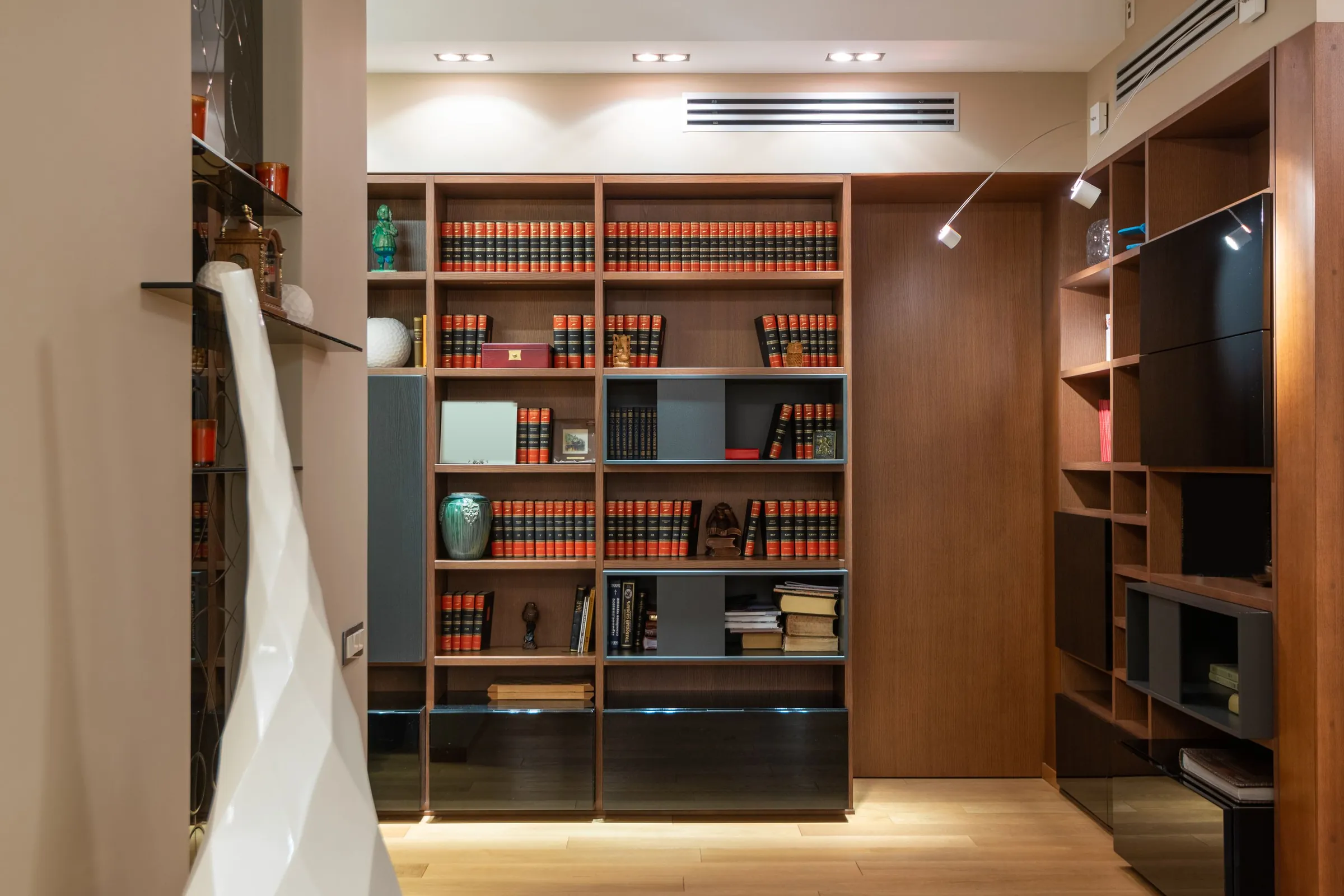
The library wall is the other showpiece, and heavy work besides. The 2009 joint woodwork standard designed library and book shelving for 50 pounds per square foot of shelf against 40 for ordinary shelving, so a wall of bound reporters is drawn with shorter spans and heavier shelf stock than a showroom bookcase, and it is fastened to the building rather than trusted to stand. The built-in cabinets behind a home library follow the same logic.
Venting a Conference Room Credenza for AV Equipment
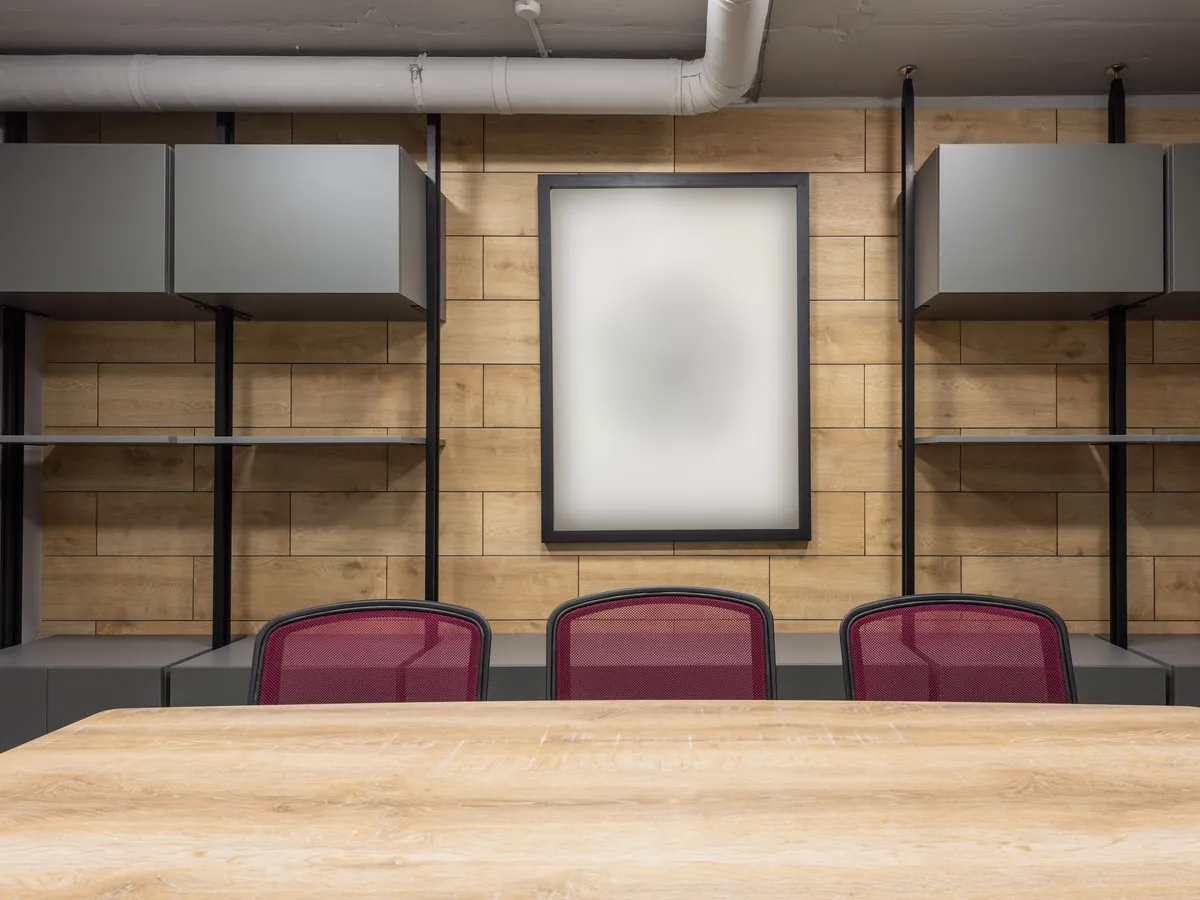
One AV rack maker gives 85 degrees Fahrenheit as the maximum recommended constant operating temperature for most equipment, and its guidance is that heat leaves a cabinet from the top, with air moving through from bottom to top. A closed wood box around a video codec, a switcher, and a network switch does the opposite. A university AV design standard shows what the built-in answer looks like: casework two bays wide with no center wall, no drawers, no cabinet floor, no toe kick, and no back, vents near the top of the doors so air enters low and leaves high, and a junction panel in the wall behind where power and cabling terminate.
A typical office credenza runs about six feet long near desk height; one freestanding model from a major office furniture maker measures 72 by 24 by 29 1/2 inches. A built-in version is sized to the wall and to the clearance and cooling specifications of the gear going inside it. Its outlets and new circuits are electrical work under permit, which Woodbury inspects itself, a far lighter permit load than a dental suite carries.
Law Office File Cabinets That Lock
Lateral files come in the office furniture industry's 30, 36, and 42 inch widths, and a built-in file bank uses the same widths so standard hanging folders fit. Filing direction decides legal-size paper. Hung side to side, a legal folder spans the drawer's depth: one major steel-file maker's 18 inch deep lateral files take legal that way, while its 15 inch wide pedestal file drawers take none at the 18 inch depth and do at 24. Hung front to back, a legal folder spans the drawer's width instead. If legal-size documents still arrive, the drawer boxes are sized for them before anything is built.
A lock is only as good as the box behind it. That same maker builds a security shield between the drawers of its lateral files so nobody reaches from one drawer into the next, and offers individual drawer locks and master keying. A built-in file bank gets the same thinking in wood: full tops, backs, and panels between drawers, locks keyed so the office manager carries one key, and the cabinet fastened to the wall or floor, which keeps a loaded bank upright without the counterweights freestanding files depend on. Minnesota's Rule 1.6(c) asks lawyers to make reasonable efforts to prevent unauthorized access to client information; locking storage is one physical measure a firm can choose, alongside its own procedures.
Records Retention and File Storage, Profession by Profession
The right size for a file wall starts with what the office has to keep on hand. These are the rules we ask about at the walk-through; your own retention policy covers the rest.
- Law firms
- Trust account and practice books for at least six years under Rule 1.15(h); the Lawyers Professional Responsibility Board's Appendix 1 allows them on paper or on computer. Client files for as long as the firm's own policy says.
- Accounting and tax offices
- IRS Publication 4557 reproduces the FTC's safeguards checklist, which includes locking rooms and file cabinets where records are kept. Federal law has return preparers keep a copy of each return, or a list, for three years after the close of the return period.
- Financial advisers
- Minnesota Rule 2876.4114 has state-registered advisers keep books and records at least five years, the first two in the principal office, so an advisory office plans room on site for whatever part of those two years it keeps on paper.
- Real estate brokers
- Minnesota Statutes 82.72 requires six years of transaction files and allows them to be kept electronically, so the question is how much paper the office chooses to hold.
Law Office Millwork: Weight, Records, and Leases
How heavy does a full file wall get?
What should happen to files the firm decides not to keep?
Can a cabinet hold wills and original documents?
Should a tenant build in or buy freestanding furniture?
Does a client signing ledge or library table have to be accessible?
Where does Premium grade make sense in a law office?
Let the Records Set the Plan
The file count and the lease terms shape the drawings. After a measure of the suite come drawings you approve and a written estimate, before anything is ordered.